


Choosing an ecommerce platform is one of the most important decisions when launching an online store. The platform you select affects your website’s design, payments, hosting, security, SEO, customization, operating costs, and ability to scale.
Two of the biggest names in ecommerce are Shopify and WooCommerce.
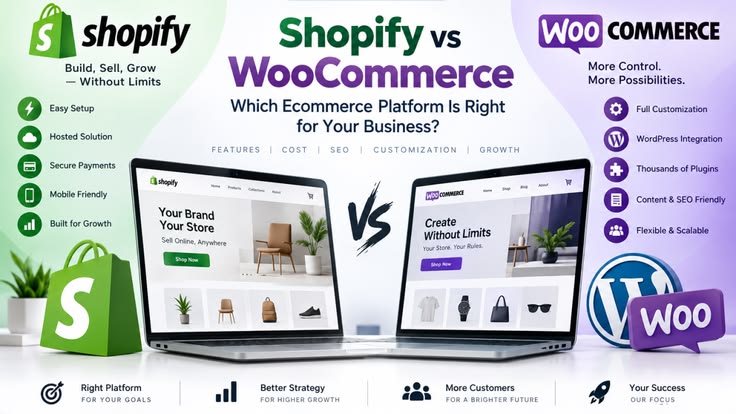
Shopify is a hosted ecommerce platform that combines hosting, store management, checkout, payments, security features, and an app ecosystem in one service. WooCommerce is an open-source ecommerce platform built on WordPress, giving merchants greater control over hosting, code, data, and extensions.
So, Shopify vs WooCommerce: which ecommerce platform is better?
There isn’t one answer for every business. Shopify and WooCommerce are built around different approaches, and the right choice depends on your technical requirements, budget, level of customization, and growth plans.

Shopify vs WooCommerce at a Glance
| Feature | Shopify | WooCommerce |
|---|---|---|
| Platform type | Hosted ecommerce platform | Open-source WordPress ecommerce platform |
| Hosting | Included | Purchased separately |
| Setup | Generally faster | Requires WordPress, hosting and configuration |
| Customization | Extensive through themes, apps and development | Extensive through themes, plugins and code |
| Technical control | More managed | Very high |
| Ecommerce features | Many built in | Expanded through extensions |
| Security | Managed platform | Merchant/host manages much of the stack |
| SEO | Built-in tools | Strong WordPress SEO ecosystem |
| Payments | Shopify Payments and third-party providers | WooPayments and many gateways |
| Apps/extensions | 8,000+ Shopify apps | Hundreds of extensions plus WordPress plugins |
| Best suited to | Businesses wanting a managed ecommerce platform | Businesses wanting control and customization |
Shopify currently describes its platform as a hosted commerce solution, while WooCommerce runs on WordPress and allows merchants to choose their own hosting environment.
1. Ease of Use
Ease of use is one of the biggest differences between Shopify and WooCommerce.
Shopify
Shopify is designed as an all-in-one ecommerce platform. Hosting, security infrastructure, checkout and many essential ecommerce tools are managed within the platform.
You can choose a theme, add products, configure payments and shipping, and start customizing your storefront without separately purchasing web hosting.
This makes Shopify particularly convenient for entrepreneurs who want to spend more time managing products, marketing and customers rather than maintaining website infrastructure.
WooCommerce
WooCommerce is installed on WordPress, which means there are more initial decisions to make.
You generally need to:
- Purchase web hosting
- Install WordPress
- Install WooCommerce
- Configure a theme
- Set up payments
- Configure security
- Manage plugins
- Maintain WordPress and extensions
The advantage is control. You can choose your hosting provider, modify your site’s code and combine WooCommerce with the huge WordPress ecosystem.
Shopify: More managed and streamlined.
WooCommerce: More setup, but significantly more control over the underlying website.
2. Design and Customization
Both platforms can create highly customized online stores.
Shopify
Shopify provides themes and a theme editor for customizing the storefront. Businesses can also use apps and custom development to add functionality.
For merchants who don’t want to manage server infrastructure, Shopify’s managed environment can make customization easier to maintain.
However, Shopify is a hosted platform with a defined architecture, so some highly specialized requirements may require working within Shopify’s ecosystem or using more advanced development approaches.
WooCommerce
WooCommerce is open source and runs on WordPress. This gives developers extensive access to the website’s code and database.
You can modify:
- Product pages
- Checkout
- Shopping cart
- Navigation
- Product filters
- Customer accounts
- Blog content
- Payment functionality
- Shipping workflows
WooCommerce explicitly emphasizes its open-source architecture and the ability to customize the storefront and underlying code.
For maximum technical control, WooCommerce offers greater freedom.
3. Pricing and Total Cost
Price comparisons between Shopify and WooCommerce can be complicated because the platforms structure their costs differently.
Shopify uses subscription plans that bundle hosting and many platform services together.
WooCommerce itself is free and open source, but operating a WooCommerce store can involve separate costs for hosting, premium themes, extensions, security, development and other services.
Shopify’s current annual-plan pricing starts at $29 per month for its Basic plan, with higher plans available for growing businesses. Shopify Plus starts at significantly higher enterprise pricing.
WooCommerce’s official comparison emphasizes that the core platform is free, while merchants can choose their hosting and add extensions according to their requirements.
Typical Shopify expenses
You may pay for:
- Shopify subscription
- Payment processing
- Premium themes
- Paid apps
- Additional services
- Custom development
Typical WooCommerce expenses
You may pay for:
- Web hosting
- Domain
- Premium theme
- Payment processing
- Premium extensions
- Security services
- Developer support
- Backup services
Therefore, “WooCommerce is free” doesn’t necessarily mean the complete store costs nothing, and a Shopify subscription doesn’t represent the entire possible cost of operating a store either.
Your actual cost depends on the features and services your business needs.
4. Payment Processing
Both platforms support multiple payment providers.
Shopify provides Shopify Payments in supported markets and also allows merchants to connect third-party payment providers. Additional transaction fees can apply depending on the payment setup and Shopify plan.
WooCommerce supports a broad selection of payment gateways through extensions. Because WooCommerce is open source, merchants can choose payment providers based on their region and business requirements.
WooCommerce’s current comparison emphasizes its support for multiple payment gateways and its ability to customize checkout.
Before choosing a platform, check which payment providers are available in your country and compare their processing fees.
5. SEO
Search engine optimization is important for ecommerce stores because organic traffic can generate customers without paying for every visit.
Both Shopify and WooCommerce can support SEO strategies involving:
- Page titles
- Meta descriptions
- Product descriptions
- Structured content
- Internal linking
- Image optimization
- Blogging
- Technical SEO
- Mobile optimization
Shopify SEO
Shopify provides built-in SEO features and allows merchants to manage important page information. Its hosted infrastructure also means merchants don’t have to independently maintain the underlying server environment.
WooCommerce SEO
WooCommerce benefits from the broader WordPress ecosystem.
WordPress provides extensive blogging and content-management capabilities, while merchants can add SEO plugins and customize technical aspects of their websites.
For content-heavy websites where blogging and editorial publishing are central to the business, WooCommerce’s WordPress foundation can be particularly useful.
Both platforms can support strong SEO. Your rankings will depend much more on site architecture, content quality, technical performance, backlinks, search intent and competition than simply choosing one platform over the other.
6. Security
Security is another important distinction.
Shopify is a managed platform. The company handles much of the underlying infrastructure, security and platform maintenance.
Shopify says its infrastructure includes encryption, access controls, backups and network security, while its hosted architecture reduces the amount of infrastructure merchants need to manage themselves.
WooCommerce gives merchants more control, but that control comes with more responsibility.
A WooCommerce store owner may need to manage:
- Hosting security
- WordPress updates
- Plugin updates
- Theme updates
- SSL configuration
- Backups
- Security plugins
- Access permissions
This doesn’t mean WooCommerce stores are inherently insecure. It means the merchant and hosting environment have a larger role in maintaining security.

7. Apps and Extensions
Both platforms can be expanded beyond their basic features.
Shopify has an extensive app ecosystem. Shopify currently says its platform has access to more than 8,000 apps.
These apps can add functionality for:
- Email marketing
- Reviews
- Loyalty programs
- Inventory
- Analytics
- Shipping
- Dropshipping
- Customer service
- Subscriptions
- Social commerce
WooCommerce takes a different approach through its extension ecosystem and the wider WordPress plugin environment.
You can add functionality for:
- Memberships
- Subscriptions
- Bookings
- Advanced product options
- Wholesale
- Multilingual stores
- SEO
- Analytics
- Marketing
- Inventory
WooCommerce also highlights its ability to combine extensions with custom code to build specialized stores.
8. Scalability
Both platforms can be used by small businesses and larger ecommerce operations, but they scale differently.
Shopify
Shopify manages the underlying hosting infrastructure, making it easier for merchants to grow without independently upgrading servers.
The platform offers products ranging from standard plans to Shopify Plus for enterprise businesses.
Shopify says its platform serves merchants across more than 175 countries and has processed more than $1.6 trillion in commerce since inception.
WooCommerce
WooCommerce can also support large stores, but scalability depends significantly on the hosting infrastructure, WordPress configuration, database, plugins and development practices.
A well-engineered WooCommerce store can be highly scalable, but businesses may need more technical expertise as traffic, products and integrations increase.
Shopify: Infrastructure is more managed.
WooCommerce: Infrastructure can be customized more extensively.
9. Blogging and Content Marketing
Content marketing can be an important part of ecommerce SEO.
WooCommerce has a natural advantage for businesses that want their online store and content operation to revolve around WordPress.
You can combine:
- Product pages
- Blog articles
- Guides
- Tutorials
- Reviews
- Landing pages
- Editorial content
Shopify also includes content-management functionality and can support blogs and SEO content. Shopify additionally provides ways to integrate with WordPress when businesses want to retain WordPress as part of their content setup.
If your business is heavily content-driven, compare the editorial workflow you prefer rather than assuming one platform will automatically perform better in search.
10. International Selling
International ecommerce introduces additional requirements, including:
- Multiple currencies
- Multiple languages
- Regional pricing
- International shipping
- Taxes
- Payment methods
- Localized content
Shopify provides international commerce tools, including multi-currency and language functionality, depending on the plan and configuration.
WooCommerce can also support international stores, with extensions and custom configurations providing significant flexibility.
However, because WooCommerce is more modular, international functionality may require more configuration.
For a business selling internationally, compare the exact markets, currencies, languages and payment methods you need before choosing a platform.
11. Product Management
Both platforms support physical and digital products.
Shopify provides centralized product management through its ecommerce administration system.
WooCommerce provides extensive product configuration and emphasizes support for customizable product types and variants. WooCommerce currently advertises unlimited product variants and product options in its platform comparison.
WooCommerce can therefore be particularly useful for stores with unusual product structures or highly customized product configurations.
Shopify, meanwhile, provides a more standardized product-management experience that can be easier for teams to operate.
12. Checkout Experience
Checkout is one of the most important parts of an ecommerce store because unnecessary friction can cause customers to abandon purchases.
Shopify provides a managed checkout system, with additional checkout customization depending on the Shopify plan.
WooCommerce allows merchants much more control over the checkout experience because the platform is open source.
This flexibility can be useful if your business requires a highly customized checkout process, but extensive customization also means more responsibility for testing, maintenance and compatibility.
Shopify cites third-party research showing a conversion advantage for its checkout, while WooCommerce presents customization and control as key advantages. These are platform-sponsored claims and should be interpreted accordingly.
13. Shopify vs WooCommerce for Beginners
If you’re creating your first online store, the biggest question is how much technical responsibility you want.
Shopify may suit you if:
- You want a hosted platform
- You want to launch quickly
- You don’t want to manage servers
- You prefer a centralized dashboard
- You want built-in ecommerce infrastructure
- You plan to use apps for additional functionality
WooCommerce may suit you if:
- You already use WordPress
- You want complete control over your website
- You are comfortable managing plugins and hosting
- You need extensive customization
- You have access to a developer
- You want to choose your own hosting and technology stack
Shopify vs WooCommerce: Which Is Better for Small Businesses?
Small businesses should consider their available time, technical expertise and budget.
Shopify can simplify the operational side of running an online store because hosting and much of the infrastructure are managed for you.
WooCommerce can provide more control over costs and functionality, but businesses may need to spend more time managing their hosting, plugins and technical setup.
Neither approach is automatically better for every small business.
A store selling a relatively straightforward product range may value simplicity, while a business with an existing WordPress website and specialized requirements may value WooCommerce’s flexibility.

Shopify vs WooCommerce: Which Is Better for Large Businesses?
Larger businesses often have more complex requirements involving:
- Multiple sales channels
- International markets
- ERP integrations
- Inventory management
- Wholesale
- B2B sales
- Custom checkout requirements
- Advanced analytics
- Multiple teams
Shopify offers Shopify Plus for enterprise commerce, while WooCommerce can be developed into highly customized ecommerce infrastructure.
At this level, the decision is less about the basic features of either platform and more about integrations, development resources, total cost of ownership, governance and the specific architecture of the business.
Shopify vs WooCommerce: Pros and Cons
Shopify Pros
- Hosted ecommerce platform
- Quick setup
- Managed infrastructure
- Centralized administration
- Extensive app ecosystem
- Built-in ecommerce features
- Strong scalability options
- Shopify POS for physical retail
Shopify Cons
- Recurring subscription costs
- Additional app costs can add up
- Less control over the underlying infrastructure
- Some advanced customization requires specific Shopify development approaches
- Third-party payment fees may apply depending on setup and plan
WooCommerce Pros
- Open source
- Free core plugin
- Extensive customization
- Full access to WordPress
- Large plugin and extension ecosystem
- Flexible hosting
- Highly customizable checkout
- Strong content-management capabilities
WooCommerce Cons
- Hosting is separate
- More maintenance responsibilities
- Plugin compatibility can require attention
- Security management requires more involvement
- Advanced stores may require developer support
Shopify vs WooCommerce: Final Verdict
Shopify and WooCommerce take fundamentally different approaches to ecommerce.
Shopify is a managed commerce platform designed to simplify store creation, hosting, security and day-to-day administration.
WooCommerce is an open-source ecommerce solution built on WordPress that gives merchants much greater control over their website, code, hosting and integrations.
If you want a streamlined, hosted ecommerce platform and prefer to minimize technical maintenance, Shopify’s model may fit your requirements.
If you already use WordPress or need extensive control over your store’s architecture, checkout, content and code, WooCommerce provides considerable flexibility.
The most important factors to compare are not just the monthly platform price. Consider hosting, payment fees, extensions, development costs, maintenance, security, scalability and the features your specific store requires.
In other words, the better platform is the one whose technical model and costs align with the way you want to run your ecommerce business.


